中文EN

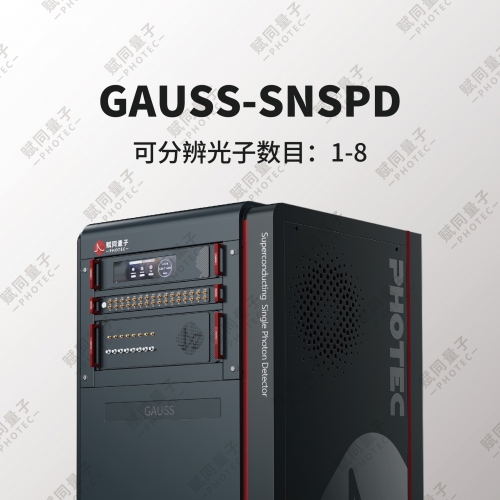
GAUSS photon-number-resolving SNSPD

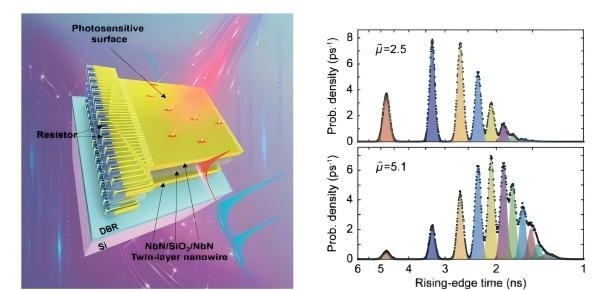
The GAUSS superconducting single-photon detection system measures photon number as well as detecting individual photons. Its nanowire structure allows the number of photons in an incident pulse to be distinguished.

The system combines high detection efficiency with the ability to distinguish one to eight photons. A specially designed electrically parallel micro- and nanostructure maps photon number to output-signal amplitude. Photon number is identified by measuring that amplitude, supporting quantum computing, quantum communication and quantum precision measurement.

Product details

GAUSS · Photon-number-resolving SNSPD

Distinguishes incident photon number while detecting single photons, providing readout for quantum sources and linear optics.

GAUSS uses specially designed superconducting nanowires to convert different photon numbers into distinguishable pulse amplitudes. It resolves 1–8 incident photons and provides photon-number distributions while retaining high detection efficiency.

1–8Resolved photon number
90%Typical single-photon fidelity
1550 nmTypical wavelengths
20–50 MHzTypical maximum count rate

Core capabilities

  • Output amplitude distributions identify photon number in each detection event.
  • For photon statistics, source evaluation and linear optical quantum computing.
  • A simplified readout architecture reduces multichannel integration complexity.
  • Supports photon-number counting and time-resolved counting.

Technical specifications

ParameterGAUSS typical configuration
Resolved photon number1–8
Typical photon-number fidelitySingle photon 90%; two photons 80%; three photons 70%; four photons 40%
Typical dark-count rate10 cps
Typical maximum count rate20 / 30 / 50 MHz
Typical wavelengths1550 nm
System dimensions675 mm × 747 mm × 1300 mm

Applications

Quantum light-source characterizationDirect measurement of single-, two- and multiphoton event distributions.
Quantum random-number samplingUses photon-number statistics as a source of quantum randomness.
Linear optical quantum computingDiscrimination and counting of multiphoton coincidences.
Fluorescence photon-yield measurementsEvaluates emitter photon statistics under weak fluorescence.
GAUSS photon-number-resolving SNSPD applications and schematic
GAUSS applications: high-performance photon-number-resolving superconducting detection | ACS Photonics (2025); Advanced Photonics 6, 016004 (2024)

Configuration and options

Photon-number fidelity decreases as the resolved photon number increases. Pulse-amplitude distributions, count rate and readout configuration affect discrimination. Select the configuration with the intended photon statistics and data analysis in mind.