
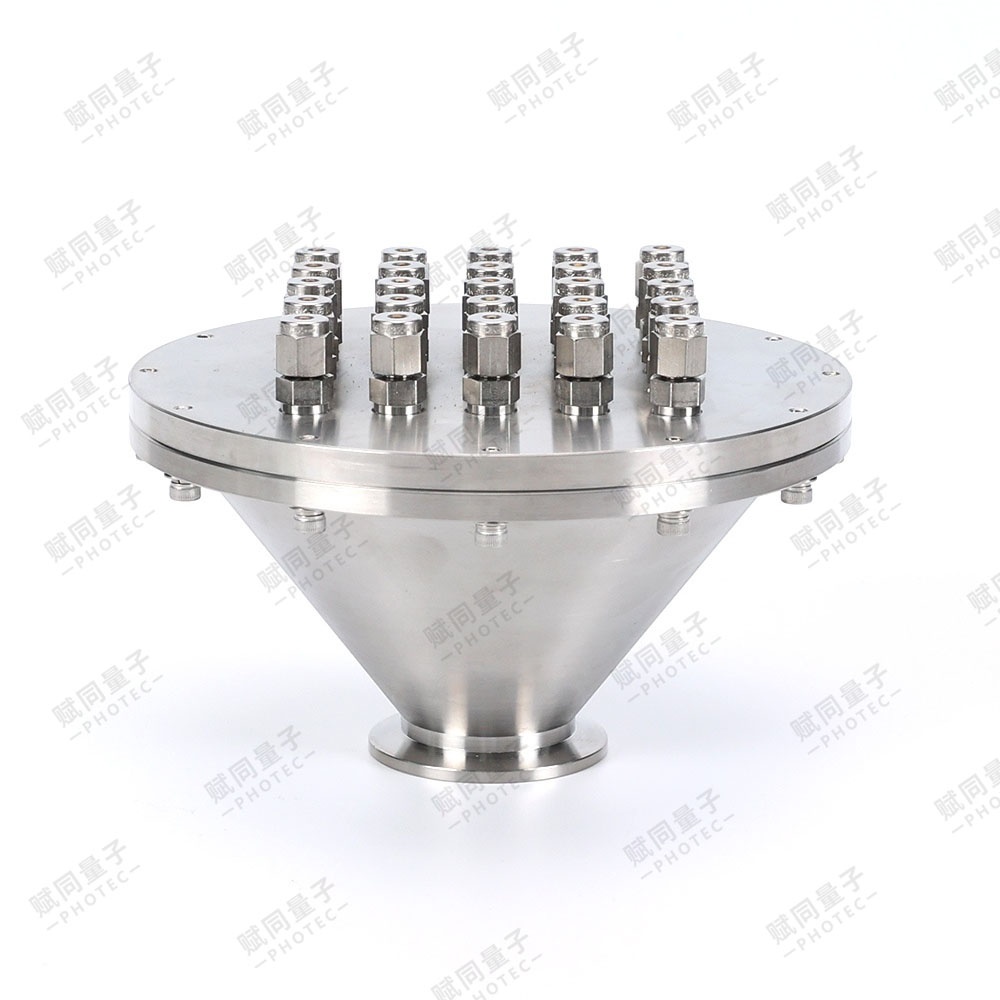
Vacuum fiber feedthrough flanges transfer optical signals between different vacuum environments. The integrated four-fiber feedthrough technology supports high-density fiber connections, with up to one hundred fibers through a single flange.
Product details
Fibre feedthroughs · High vacuum and cryogenic optics
Transfers light between vacuum, cryogenic and room-temperature environments with single-mode, multimode or polarization-maintaining fibers.
High-vacuum fiber flanges provide low-loss transmission across a vacuum wall. One flange can contain 1–100 fiber channels with KF, CF, ISO or customized interfaces for cryogenic optics, quantum optics and in-vacuum imaging.
1–100Fibre channels
≤0.01 dBAdded loss per channel
<1E-8 mbarVacuum environment
SM / MM / PMFibre type
Core capabilities
- Highly integrated flanges accommodate multiple fiber channels.
- Supports single-mode, multimode and polarization-maintaining fibers.
- KF, CF, ISO and custom flange interfaces.
- Low added loss for in-vacuum optics and cryogenic optical measurements.
Technical specifications
| Parameter | Typical specification |
|---|---|
| Operating vacuum | Better than 1×10⁻⁸ mbar |
| Fibre type | Single-mode / multimode / polarization-maintaining |
| Channel count | 1–100, selectable |
| Fibre loss | ≤0.01 dB |
| Interface type | Standard CF / KF / ISO or custom flange |
| Mounting method | Vacuum-wall bulkhead mounting |
| Environments | High vacuum, ultrahigh vacuum and cryogenic optical systems |
Applications
Cryogenic optics and single photonsRoutes pump and signal light into or out of cold sample chambers.
In-vacuum microscopy and imagingMultichannel optical transfer across vacuum boundaries.
Quantum optical systemsPolarisation-maintaining and multimode fiber routing.
Research vacuum equipmentFeedthroughs configured for chamber interfaces and optical channel count.
Configuration and options
Fibre type, core diameter, wavelength, connectors, channel layout and flange standard affect loss and vacuum performance. Confirm multichannel and polarization-maintaining configurations during selection.